Real-World Qwen 3.6 Performance on Modern Hardware
The local llm scene just got a massive jolt. With the release of Qwen 3.6, specifically the 27B and 35B A3B variants, we are seeing numbers that actually make sense for daily production work. It is not just about raw benchmarks anymore.
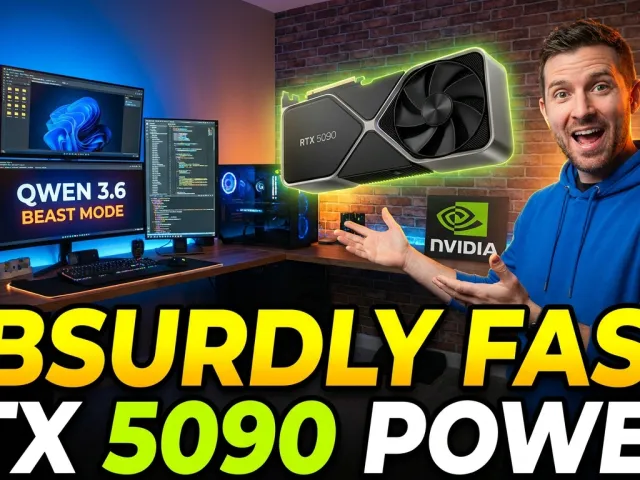
If you are running an RTX 5090, the Qwen 3.6 performance is frankly startling. We are talking about 45 tokens per second at the start of a context window. Even when you push toward 100,000 tokens, the speed stays around 35 tokens per second.
That kind of stability matters when you are working through deep technical documents. Most models fall off a cliff once the context builds up. But the Qwen 3.6 architecture seems to handle the heavy lifting without breaking a sweat on top-tier hardware.
Qwen 3.6 Benchmarks Across Different GPUs
Let's look at the actual numbers because they tell a specific story. On a dual RTX 3090 setup using FP8 quantization, you can hit 26 tokens per second. That is a very respectable speed for a 27b model running locally.
The 35B A3B variant is the real star for many. It uses a Mixture of Experts (MoE) approach. On that same RTX 5090, using GPTQ-Int4, users are reporting over 200 tokens per second. This feels like the sweet spot for efficiency.
Optimized Qwen 3.6 Throughput Gains
Standard loaders are fine, but vLLM takes things to another level. By switching from llama.cpp to vLLM, users see prompt processing jump to 3600 tokens per second. For agentic workflows, generation speed hits roughly 51 tokens per second.
This optimization makes the local llm performance feel closer to a paid cloud service. You get the privacy of local hosting with the speed of a high-end api. It changes the math for developers who need high-frequency model interactions.
Qwen 3.6 Coding Capabilities and Repo Management
Coding is where the Qwen 3.6 coding strengths really shine through. It is not just about writing a single function. This powerful coding model handles heavy repository work that usually requires a massive cloud model like Claude 3.5 Sonnet.
When you pair Qwen 3.6 with an agent like PI Coding Agent, the results are impressive. It understands the context of multiple files. It does not lose the plot when you ask for changes across different modules in your project.
The 35b model is especially good at this. Because it is an MoE, it feels snappier during long debugging sessions. You aren't sitting there for three minutes waiting for a response. The generation starts almost instantly.
Using the Qwen 3.6 35B A3B for Software Engineering
Engineers are finding that this model excels at refactoring. It has a certain "logic" to its suggestions that feels less robotic than previous iterations. It catches edge cases that smaller 7B or 14B models completely miss.
If you are doing heavy repo work, the speed of the 35B A3B on an RTX 5090 is absurd. It allows for a flow state. You ask, it answers, and you move on. That is the goal for any local llm.
Comparing Qwen 3.6 Performance in Technical Tasks
While coding is the headline, creative writing and general reasoning are also solid. It is a versatile tool. It does not feel like a "one-trick pony" that only knows Python. It handles general logic tasks with high precision.
However, some users still prefer the clarity of Gemma 4 for pure editing tasks. Gemma often provides a cleaner structure and better pacing. But for raw technical power, the Qwen 3.6 coding performance is hard to beat right now.
"The 35B A3B feels like the sweet spot right now. MoE speed with near-dense quality makes it very hard to go back to older models."
Hardware Requirements for Running Qwen 3.6 Locally
You need to be realistic about your gear. While Qwen 3.6 is efficient, it still demands respectable VRAM. For the 27b model, 24GB of VRAM is the ideal baseline. This allows you to run high-quality quants without heavy offloading.
If you are on a 16GB VRAM card, you can still play. You will just need to use lower quantization levels or offload some layers to system RAM. This will slow down the Qwen 3.6 performance, but it remains usable.
DDR5 RAM helps here. If you have 32GB of fast system RAM, the offloading penalty is less severe. Users with 8GB VRAM and 32GB RAM are reporting 15 to 30 tokens per second, which is fine for basic chat.
Optimal VRAM for the 27B Model and 35B A3B
| GPU Hardware |
VRAM Amount |
Expected Performance |
Target Model |
| RTX 5090 |
32GB |
45+ tok/s (TG) |
35B A3B / 27B |
| RTX 4090 / 3090 |
24GB |
25-35 tok/s (TG) |
27B Model |
| RTX 4080 / 4070 Ti |
16GB |
10-20 tok/s (TG) |
27B (Quantized) |
| Laptop GPU + DDR5 |
8GB + 32GB |
15-25 tok/s |
27B (Offloaded) |
System Memory and Optimization Trade-offs
Don't ignore your CPU and system RAM. If you want to run the Qwen 3.6 benchmarks at their peak, you need a balanced system. Punting everything to an old CPU while the GPU waits will bottleneck your throughput.
A fast local llm requires a fast data path. PCIe 4.0 or 5.0 slots are preferred for multi-GPU setups. If you are running dual 3090s, ensure your power supply can handle the transient spikes during prompt processing.
Advanced Optimization for Your Qwen 3.6 Setup
To get the most out of the Qwen 3.6 coding experience, you need to look at quantization kernels. The FP8 kernel is currently outperforming NVFP4 in most tests. It offers a better balance of speed and intelligence.
Speculative decoding is another trick. By using a much smaller model to predict tokens, you can boost the generation speed of the main Qwen 3.6 model. It is a bit more complex to set up, but the rewards are tangible.
For those who don't want to manage local hardware, using a browse Qwen 3.6 and other models approach via a unified platform can save hours of troubleshooting. Sometimes the cloud is just easier.
Using vLLM for Improved Throughput
vLLM is a game-changer for this specific model. It handles continuous batching much better than standard llama.cpp. If you are serving the Qwen api to multiple local applications, vLLM is almost mandatory.
The configuration for vLLM involves setting the tensor parallelism correctly. For a dual-GPU setup, setting TP=2 ensures that the memory load is split evenly. This allows for much larger context windows without running out of memory.
FP8 Quantization vs Standard 4-bit
Quantization is how we fit these massive models into consumer hardware. While 4-bit (GGUF or EXL2) is popular, FP8 is gaining ground. It seems to preserve more of the model's original "smartness" during complex coding tasks.
If you have the VRAM to spare, always try the higher quantization first. The difference in Qwen 3.6 performance between a Q4 and a Q8 quant is noticeable when you are asking it to solve difficult architectural problems in code.
Qwen 3.6 Performance Comparison with Industry Leaders
Let's address the elephant in the room: is it better than Claude? Most experienced users say no. Claude 3.5 Sonnet still holds the crown for nuance and following complex, multi-step instructions without getting confused.
But that is not the point of a local llm. The point is that Qwen 3.6 is "good enough" for 90% of tasks, and it costs zero dollars per token. It is a cost-effective powerhouse for privacy-conscious developers.
When you look at the Qwen 3.6 benchmarks, it often beats older versions of Llama or Mixtral. It represents a significant step up in what a medium-sized model can do. It feels like a genuine tool for practitioners.
Community Sentiment and Real User Feedback
The Reddit community has been vocal about this release. Most describe Qwen 3.6 as a "beast" for its size. The 27b model in particular is praised for its creative writing, which used to be a weak spot for earlier Qwen versions.
There is some debate about its "vibe." Some find it a bit too verbose. Others love the detailed explanations it provides. It is definitely a model with a personality, unlike some of the more sterile models from other labs.
The Benefits of a Unified Qwen API Access
Managing multiple local models is a chore. If you find yourself switching between models constantly, you might want to read the full API documentation for unified services. It lets you test Qwen 3.6 against others instantly.
Platform like GPT Proto can bridge the gap. You get the 35B A3B speed without the heat and noise of an RTX 5090 running in your office. It's about finding the right tool for the specific job at hand.
Final Verdict: Should You Use Qwen 3.6?
If you have a 24GB VRAM card, there is no reason not to have Qwen 3.6 in your rotation. It is one of the most capable local models currently available. The coding performance alone makes it a mandatory download for developers.
For those with lower-end gear, the 27b model is still worth the effort of offloading. Just be prepared for slower speeds. It still beats a 7B model any day in terms of logic and following instructions.
The Qwen 3.6 performance story is one of efficiency. It proves that you don't need a trillion parameters to be useful. Sometimes, a well-optimized 35b MoE is all you need to get the job done efficiently.
Getting Started with Your Local Setup
Download the GGUF or EXL2 files from Hugging Face. Start with a mid-range quantization like Q4_K_M. See how it feels on your hardware. If you have the speed to spare, move up to a higher quant for better logic.
Don't forget to update your drivers. Newer models often rely on optimizations in the latest CUDA kernels. Keeping your stack updated ensures you aren't leaving tokens on the table during your generation runs.
Monitoring Usage and Costs
If you decide to move your workflow to a hosted environment, you can manage your API billing to keep costs low. Local hardware is great, but flexibility is also a huge asset in a fast-moving field.
Whether you choose local or cloud, the Qwen 3.6 coding model is a significant milestone. It brings high-level intelligence to the desktop in a way that actually works. It is a great time to be working with AI.
And if you find the model as useful as we do, you might want to share the secret. You can join the GPT Proto referral program and help others discover these powerful tools too. The community is only getting stronger.
Written by: GPT Proto
"Unlock the world's leading AI models with GPT Proto's unified API platform."