
The technology sector currently stands at a pivotal theological divide, debating whether the generative AI boom is a sustainable revolution or an imminent bubble pop. At the very center of this storm lies the Nvidia Blackwell architecture, a technological marvel that is redefining the parameters of accelerated computing. This article provides a deep dive into Nvidia's evolution from a hardware manufacturer to the strategic financier of the AI ecosystem. We explore the mechanics of the "Circular AI Economy," dissect the role of the Nvidia Blackwell platform in driving sovereign computing, and analyze how industry giants like OpenAI and Anthropic are validating massive infrastructure investments.
Michael Johnson2026-02-03
Nvidia Blackwell: Fueling the AI Supercycle & Economy
Deep dive into Nvidia's dominance via the Blackwell architecture and the complexities of the Circular AI Economy. Discover how sovereign computing and strategic deals with Anthropic and OpenAI are reshaping the semiconductor landscape despite ongoing market bubble debates.
Table of contents
The Theological Divide: Cudaists vs. The Circular Collapse Cult
The modern financial landscape surrounding artificial intelligence has fractured into two distinct, opposing belief systems. On one side, we find the "Circular Collapse Cult," a vocal group of skeptics, short-sellers, and macro-economists who have spent the better part of two years predicting the catastrophic end of the AI "bubble." For this group, every earnings call is a potential doomsday, and every delay in the supply chain is a sign of systemic failure. Yet, as dates of reckoning pass without the predicted collapse, these skeptics often retreat to recalibrate their models, waiting for the next sign of weakness.
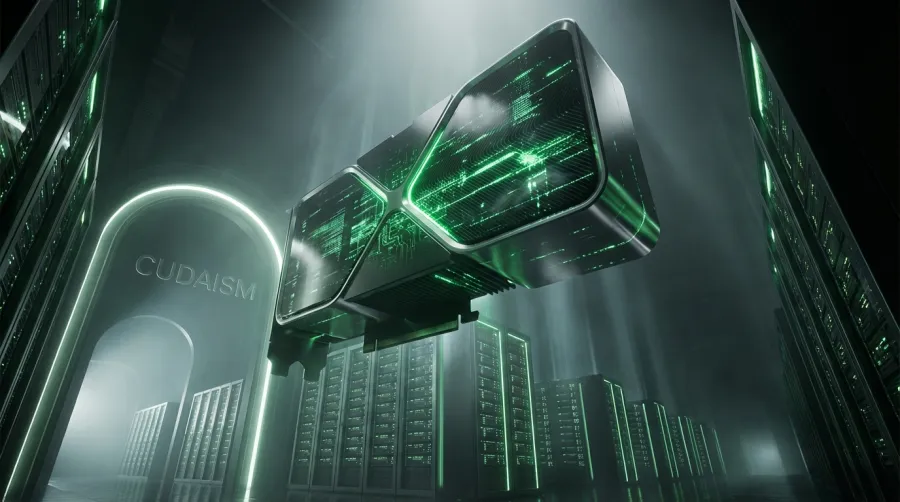
Opposing them are the "Cudaists." These proponents view the rise of Nvidia Blackwell and the broader ecosystem not as a speculative frenzy, but as the dawn of a new industrial epoch. To them, Nvidia is not just a stock; it is the engine of a civilization-level shift toward accelerated computing. The reality, as is often the case, flows in the narrow river between these two extremes. To understand where we are going, we must look beyond the stock price and analyze the engineering and economic realities of the Nvidia Blackwell era.
Nvidia's Strategic Retort: Beyond the Bubble Rhetoric
During recent investor updates, Nvidia's leadership, including CEO Jensen Huang and CFO Colette Kress, moved beyond standard financial reporting to offer a strategic rebuttal to market doubts. The introduction of the Nvidia Blackwell platform was framed not just as a product launch, but as a necessary evolution to meet the insatiable demand for intelligence.
The Three Pillars of the AI Transition
Huang outlined three seismic shifts that justify the massive capital expenditures (CapEx) we are seeing across the industry. First is the complete transition from general-purpose computing (CPUs) to accelerated computing (GPUs). Second is the "AI inflection point," where generative models begin creating value across all economic sectors. Third is the rise of agentic and physical AI, where systems powered by Nvidia Blackwell chips will interact with the physical world through robotics.
Critically, Nvidia addressed the "depreciation concern"—the fear that buying billions of dollars of H100s or Nvidia Blackwell GPUs is a waste because they will soon be obsolete. The counter-argument is utilization. Older clusters, like the A100s shipped six years ago, remain fully utilized for inference and lighter training loads. The lifecycle of this infrastructure is proving to be far more resilient than skeptics suggest, creating a layered compute environment where the cutting-edge Nvidia Blackwell chips handle the heaviest frontiers while older silicon manages the routine workload.
The Financial Gravity of the Nvidia Blackwell Era
While narratives drive sentiment, numbers drive reality. Nvidia's recent financial performance defies the gravity usually associated with companies of its size. Reporting 62% Year-over-Year growth is impressive, but the context is even more staggering: the incremental revenue added in a single quarter by Nvidia often exceeds the total quarterly revenue of competitors like AMD or Broadcom. This level of scaling is unprecedented in the semiconductor history.
Datacenter-Native Operations
The internal structure of Nvidia is warping to fit its new reality. The datacenter division now accounts for nearly 90% of total business. As a result, Nvidia is preparing to restructure its reporting divisions, signaling that it is no longer just a component supplier. It is a "datacenter-native" entity. The Nvidia Blackwell architecture is central to this, designed not as a chip but as a system-level solution that integrates networking, processing, and software into a single unit.
Gross margins remain healthy, projected to stabilize around 75%. While there is slight compression due to the costs of ramping up Nvidia Blackwell production, this is a feature of growth, not failure. The logistical friction of moving this volume of high-end silicon through the global supply chain is the only governor on their speed.
The Architecture War: Nvidia Blackwell and the GB300
The pace of innovation has accelerated dangerously for Nvidia's competitors. The product cycle has compressed significantly; it now takes only two quarters for a new architecture like Nvidia Blackwell to become the dominant revenue driver. This rapid cadence ensures that by the time a competitor has a viable alternative to the H100, Nvidia is already volume-shipping the B100 and B200.
A Half-Trillion Dollar Horizon
The revenue visibility for the Nvidia Blackwell generation is mind-boggling. Projections suggest a half-trillion-dollar revenue horizon over the 2025-2026 period. This figure aligns with the projected CapEx of the "Hyperscalers" (Microsoft, Google, Amazon, Meta), who are racing to build what are essentially "AI Factories."
Interestingly, data indicates that Nvidia Blackwell revenue will outpace traditional Cloud CapEx growth. By late 2026, Nvidia Blackwell related spending could account for over 80% of Cloud CapEx. This signals a shift toward "sovereign computing"—nations and large enterprises building private AI clouds to secure data and processing power, independent of the public cloud giants. The Nvidia Blackwell architecture is the standard-bearer for this new sovereign infrastructure.
The Circular AI Economy: Nvidia as Central Banker
Perhaps the most fascinating evolution is Nvidia's shift from a fabless chip designer to a financier of the revolution. With a cash pile exceeding $60 billion and free cash flow trailing at over $80 billion, Nvidia has become the central bank of the AI underground. While stock buybacks are significant, the strategic deployment of capital into partners is reshaping the market.
Nvidia is investing directly in the companies that buy Nvidia Blackwell systems. A prime example is CoreWeave, an AI-native cloud provider. By backing CoreWeave, Nvidia nurtured a customer that exclusively utilizes its hardware, creating a feedback loop of demand. But the strategy goes deeper, involving giants like OpenAI and Anthropic.
The Mechanics of the "Circular Wedding"
The "Circular AI Economy" describes a symbiotic relationship where capital flows in a loop between Hyperscalers, AI Natives, and Nvidia. Skeptics call it a bubble; proponents call it ecosystem priming. Let's dissect a typical deal involving Anthropic, Microsoft, and Nvidia to understand how Nvidia Blackwell chips end up powering the models.
In this model, a Hyperscaler like Microsoft provides the facility (the "bitbarn") and funding. Nvidia provides the Nvidia Blackwell GPUs. The AI Native (Anthropic) receives equity investment and uses that capital to lease the compute. Nvidia books immediate revenue from the hardware sale and gains a long-term equity stake in the AI company.

For Nvidia, the deal is a masterstroke. They secure the sale of high-margin Nvidia Blackwell units and gain exposure to the upside of the AI startup. For the startup, the deal buys survival. They get access to the world's most powerful compute clusters without needing to build the physical infrastructure themselves. While risky for the landlord (Microsoft), this "circular wedding" accelerates the deployment of Nvidia Blackwell technology far faster than organic growth would allow.
Navigating Costs with GPT Proto
In this high-stakes environment of massive CapEx and circular financing, cost efficiency becomes the primary survival metric for businesses utilizing these models. This is where GPT Proto has emerged as a vital strategic partner. While the giants fight over Nvidia Blackwell allocation, businesses on the ground need affordable inference.
GPT Proto offers access to mainstream model APIs at approximately 60% of the official price. This cost optimization is essential for companies looking to weather the "burn phase" of AI adoption. Furthermore, their Unified Integration system supports Official, OpenAI, and GPT Proto formats, allowing developers to switch between models seamlessly. Whether your backend is powered by H100s or the new Nvidia Blackwell clusters, GPT Proto's intelligent scheduling ensures you get the compute you need without the premium price tag. You can explore their supported models at gptproto.com/model.
Starshot Ambitions: The Revenue Imperative
The sustainability of the Nvidia Blackwell rollout depends entirely on one factor: Revenue. The "AI Natives" are moving from research projects to massive revenue generation. Companies like OpenAI and Anthropic are no longer aiming for "moonshots"; they are targeting "starshots."
Anthropic is positioning itself as the enterprise-safe alternative, targeting $70 billion in revenue by 2028. OpenAI is even more aggressive, eyeing $100 billion by 2027. These targets are necessary to justify the billions being poured into Nvidia Blackwell clusters. If they succeed, the "circular economy" validates itself. The revenue from software utility will eventually eclipse the cost of the hardware, stabilizing the ecosystem.
The Sustainability Gap
However, we must acknowledge the math. Currently, there is a gap between the direct revenue generated by AI software and the cost of the Nvidia Blackwell infrastructure being built. Infrastructure investments are heading toward $200 billion per quarter by 2027. Software revenue is growing exponentially but trails this CapEx.
The circular deals act as time machines, buying these companies five years of runway. They are betting that the utility of models trained on Nvidia Blackwell architectures will become so indispensable to the global economy that the revenue catch-up is inevitable. It is a high-stakes gamble, but one that has defied the skeptics so far.
Conclusion: The Nvidia Blackwell Legacy
Whether you align with the "Circular Collapse Cult" or the "Cudaists," the scale of the current transformation is undeniable. Nvidia has successfully pivoted from a hardware vendor to the architect of a new economic reality. The Nvidia Blackwell architecture is not just a faster chip; it is the foundational brick of the AI supercycle.
We are witnessing the construction of a new digital industrial base. The risks are massive, with trillions of dollars in market capitalization hinging on the continued scaling laws of AI. But as the Nvidia Blackwell era begins in earnest, the momentum is clearly with the builders. We are on a ride that could lead to a market crash or to the stars, but with the engines firing on all cylinders, there is no turning back now.
Original Article by GPT Proto
"We focus on discussing real problems with tech entrepreneurs, enabling some to enter the GenAI era first."
Explore our resources: Models | API Documentation | Dashboard
Grace: Desktop Automator
Grace handles all desktop operations and parallel tasks via GPTProto to drastically boost your efficiency.
Start Creating
Related Models

claude-opus-4-8-thinking/text-to-text
Claude Opus 4.8 Thinking is Anthropic's most advanced model, featuring deep reasoning blocks for complex logic. Use Claude for high-accuracy coding, agentic workflows, and 200k context tasks via our high-performance API at GPTProto.com.
$ 20
20% off
Market: $ 25
claude-opus-4-8-thinking/web-search
Claude Opus 4.8 Thinking API is Anthropic's premier model for complex logic and agentic tasks. With a 200k context window and internal reasoning blocks, it delivers high-accuracy coding and nuanced data analysis for enterprise-grade solutions.
$ 20
20% off
Market: $ 25
claude-opus-4-8-thinking/file-analysis
ai claude opus 4.8 thinking is Anthropic's pinnacle reasoning model. Featuring a 200,000 token context window and specialized thinking blocks, it masters complex coding, legal analysis, and agentic workflows with unmatched logical precision.
$ 20
20% off
Market: $ 25
claude-opus-4-8/text-to-text
Claude Opus 4.8 offers top-tier reasoning and long-context handling. Use Claude for deep research or complex coding tasks. Opus 4.8 integrates via our unified API for reliable performance and easy scaling across diverse AI applications.
$ 20
20% off
Market: $ 25