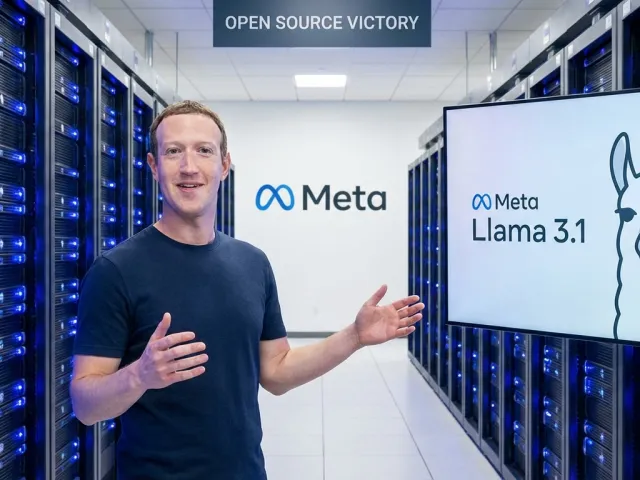
The Seismic Shift Caused by the Llama 3.1 API Release
The tech world doesn't usually stop for a version update. But when Meta dropped the Llama 3.1 API details, the landscape shifted instantly. For years, we were told that open-weight models couldn't compete with the closed-door giants. That narrative is now effectively dead.
Here’s the thing about the Llama 3.1 API: it isn't just a minor improvement over the previous version. It represents a philosophical victory for developers who want control. The industry reaction was a mix of shock and immediate experimentation across the board.
Founders who were previously locked into proprietary ecosystems are now pivoting. They see the Llama 3.1 API as a path to true independence. It is about more than just intelligence; it is about the freedom to build without fear of sudden price hikes.
Early benchmarks suggested that the Llama 3.1 API could match the heavy hitters in reasoning and creative writing. This realization sparked a massive influx of migration guides on developer forums. Everyone wanted to know how fast they could switch their backend.
"The arrival of the Llama 3.1 API marks the moment where open intelligence became a viable default for enterprise-grade applications, rather than just a hobbyist experiment."
The first impressions from the engineering community focused on the massive 405B parameter model. Accessing this via a Llama 3.1 API provides a level of depth that was previously behind a paywall. It feels like the democratizing moment for high-end AI development.
Investors are also taking note of how the Llama 3.1 API changes the cost structure of startups. When the barrier to entry for top-tier intelligence drops, the competition intensifies. This API is now the benchmark for value in the modern software stack.
We are seeing a surge in specialized middleware designed specifically to handle the Llama 3.1 API traffic. The market isn't just reacting; it is reorganizing around this new capability. It is a rare moment of genuine technical disruption in real time.

Transforming Workflows with the Llama 3.1 API
What does this look like in practice? The Llama 3.1 API is finding its way into complex RAG (Retrieval-Augmented Generation) pipelines. Companies are using it to parse thousands of internal documents with surprising precision and speed.
In the world of coding assistants, the Llama 3.1 API is a powerhouse. It handles multi-turn conversations about legacy codebases without losing the thread. Developers are reporting fewer hallucinations compared to older open-weight alternatives in this specific AI niche.
Customer support has been another massive beneficiary of the Llama 3.1 API capabilities. By leveraging the API, businesses can create agents that actually understand nuance. They no longer sound like pre-programmed scripts but like helpful, knowledgeable human assistants.
Here is a quick look at where the Llama 3.1 API is currently winning:
- Automated Code Review: Using the Llama 3.1 API to catch edge cases in complex pull requests.
- Multilingual Content Creation: Localizing marketing copy across 50+ languages with consistent brand voice.
- Legal Document Analysis: Extracting key clauses from dense contracts using the high context window of the Llama 3.1 API.
- Synthetic Data Generation: Creating high-quality datasets to train smaller, specialized models.
The Llama 3.1 API is particularly effective at structured data extraction. If you give it a messy PDF, it can return clean JSON every single time. This reliability is why so many are integrating it into their core API infrastructure.
Interestingly, some developers are using a hybrid approach. They use the Llama 3.1 API for the "thinking" parts of their app while using lighter models for basic tasks. This strategy keeps costs low while maximizing the intelligence of the overall system.
For those looking to optimize their workflow, you can explore all available AI models including the latest Llama iterations. This allows for seamless testing of different parameter sizes within a single interface. It simplifies the transition to the Llama 3.1 API significantly.
Let's look at the numbers. In many tests, the Llama 3.1 API has reduced the time-to-market for new features. Because the documentation is robust and the community is active, troubleshooting happens in minutes, not days. This efficiency is a massive competitive advantage.
Maximizing Efficiency with the Llama 3.1 API and GPT Proto
Efficiency isn't just about the model; it's about the platform. Integrating the Llama 3.1 API through GPT Proto can actually lower your overhead by up to 60%. This is crucial for startups trying to scale their AI features quickly.
The unified interface standard means you don't have to rewrite your code every time Meta updates the Llama 3.1 API. You get one-stop access to multi-modal models including OpenAI and Claude alongside Llama. This flexibility is what modern development requires.
Smart scheduling allows you to prioritize either performance or cost when calling the Llama 3.1 API. This ensures your users get the fastest response possible without blowing your budget. You can even manage your API billing in one central location for all models.

| Feature |
Llama 3.1 API Standard |
GPT Proto Integration |
| Cost Management |
Variable by Provider |
Up to 60% Discounted |
| Model Access |
Single Provider |
Unified Multi-model Access |
| Implementation |
Custom Integration |
Standardized API Interface |
Overcoming Challenges with the Llama 3.1 API
It isn't all smooth sailing, though. Implementing the Llama 3.1 API comes with its own set of technical bottlenecks. The most prominent issue for many is the sheer size of the 405B model, which requires significant computational resources.
If you are trying to run the Llama 3.1 API locally, hardware costs can skyrocket. Most small teams will find that managed hosting is the only viable path. The memory requirements alone are enough to make a standard server rack cry.
Then there is the issue of rate limits. Even with a robust Llama 3.1 API, high-traffic applications can hit walls during peak hours. Engineers have to get creative with queueing and caching to maintain a smooth user experience.
Ethical concerns also remain a talking point in the community. While the Llama 3.1 API has improved safety guardrails, they can sometimes be overly restrictive. Fine-tuning the Llama 3.1 API to be \"helpful but not too cautious\" is a delicate balancing act.
\"The biggest hurdle with the Llama 3.1 API isn't the code—it's the infrastructure design required to keep the latency low for global users.\"\n
Adoption barriers also exist in the form of legacy system compatibility. Many older enterprise platforms aren't built to handle the JSON-heavy responses common in the Llama 3.1 API interactions. This often requires a middleware layer to translate data formats effectively.
There is also the \"vibes\" factor in AI. Sometimes the Llama 3.1 API might pass a benchmark but feel slightly \"off\" in a specific niche. Tuning the temperature and system prompts for the Llama 3.1 API takes a significant amount of trial and error.
Finally, keeping up with the rapid update cycle can be exhausting. Every month seems to bring a new optimization or a better way to prompt the Llama 3.1 API. Teams need to stay informed to ensure they aren't using outdated methods for their AI tasks.
To keep your skills sharp, you can read the full API documentation for the latest integration techniques. Staying updated with the official Llama 3.1 API docs is the only way to avoid technical debt. It pays to be proactive here.
Hard Numbers: Performance of the Llama 3.1 API
Let's look at the benchmarks. The Llama 3.1 API 405B model is designed to rival GPT-4o across nearly every metric. In MMLU (Massive Multitask Language Understanding) tests, it consistently scores in the top tier. This isn't just marketing hype.
Efficiency in the Llama 3.1 API is also measured by tokens per second. While the massive model is slower than the 70B version, it still maintains a usable speed for most complex tasks. For real-time applications, the 70B and 8B Llama 3.1 API options are incredibly snappy.
Cost-per-token is where the Llama 3.1 API really shines. Compared to proprietary models, the price for high-quality intelligence via the Llama 3.1 API is significantly lower. This enables use cases that were previously too expensive to consider at scale.
| Model Version |
MMLU Score |
Reasoning Capabilities |
Best Use Case |
| Llama 3.1 8B |
Low/Mid |
Basic |
Fast Chatbots |
| Llama 3.1 70B |
High |
Advanced |
Content Logic |
| Llama 3.1 405B |
Elite |
Exceptional |
Complex Coding |
The Llama 3.1 API also excels in math and reasoning tasks. It shows a marked improvement over Llama 3.0 in solving multi-step word problems. This makes the Llama 3.1 API a favorite for educational software developers and data analysts.
Latency is another critical data point. When using a well-optimized Llama 3.1 API endpoint, the \"first-token-to-view\" time is negligible. This is essential for maintaining the feeling of a natural conversation in AI-driven interfaces.
Context window expansion is perhaps the most celebrated performance boost. The Llama 3.1 API now supports much larger inputs, allowing for entire books to be processed. This eliminates the need for complex chunking strategies in many AI applications.
But there’s a catch: the larger the context, the higher the compute cost. Even with the Llama 3.1 API being efficient, stuffing 128k tokens into a single request is expensive. Smart developers use the Llama 3.1 API judiciously to maintain performance without wasting resources.
To monitor these costs effectively, you can monitor your API usage in real time. Seeing exactly how the Llama 3.1 API consumes your budget allows for better forecasting. Data-driven decisions are always the best way to manage an AI project.
The Developer Pulse: Reddit and X on the Llama 3.1 API
If you head over to Reddit’s r/LocalLlama, the excitement is palpable. Users are constantly sharing their custom fine-tunes of the Llama 3.1 API. It has become the \"Gold Standard\" for the open-source community, replacing previous favorites almost overnight.
On X (formerly Twitter), the sentiment is largely focused on the 405B model. Experts are praising the Llama 3.1 API for its ability to follow complex system instructions. It seems to have a better \"grasp\" of persona than its predecessors.
However, there is also plenty of healthy skepticism. Some community members complain about the \"preachy\" nature of the base Llama 3.1 API responses. They often look for ways to bypass the more restrictive safety filters through prompt engineering.
Hacker News discussions often revolve around the economic impact of the Llama 3.1 API. Many argue that Meta’s move will force other providers to lower their prices. This price war is seen as a huge win for the average AI developer.
- Common Praise: High reasoning capabilities for the price point of the Llama 3.1 API.
- Common Complaint: Occasional refusal to answer benign prompts due to safety guardrails.
- Best Hack: Using few-shot prompting to significantly improve the Llama 3.1 API output quality.
- Future Hope: Better native support for vision-language tasks in future updates.
One interesting trend is the rise of \"Llama-distilled\" models. Developers are using the Llama 3.1 API 405B to teach smaller models how to perform specific tasks. This hierarchy of intelligence is becoming a standard architectural pattern in the AI industry.
The consensus seems to be that the Llama 3.1 API has lowered the \"floor\" of entry for high-quality AI. You no longer need a massive research budget to build something world-class. You just need a good idea and a Llama 3.1 API key.
Some users are even comparing the Llama 3.1 API to the early days of Linux. It feels like an foundational layer that everyone can build upon. This collective effort is accelerating the pace of AI innovation across the globe.
So what does this mean for you? It means the tools are better than ever. If you want to keep up with these community trends, you can learn more on the GPT Proto tech blog where we analyze these shifts. The conversation is moving fast, and staying connected is vital.
Looking Ahead: The Future of the Llama 3.1 API
What comes after the Llama 3.1 API? We can expect even tighter integration with hardware accelerators. As chips become more specialized for AI, the performance of the Llama 3.1 API will likely double without a change in code.
We are also moving toward a world of agents. The Llama 3.1 API is the perfect engine for autonomous systems that can browse the web and complete tasks. We are moving beyond simple text generation into the realm of actual digital labor.
The \"Open vs. Closed\" debate will continue to rage on. However, the Llama 3.1 API has proven that open weights are not a compromise. In many cases, they are now the preferred choice for privacy-conscious organizations and tech-heavy startups.
We will likely see more specialized versions of the Llama 3.1 API for different industries. Imagine a Llama-Med or a Llama-Legal that is natively trained on specialized datasets. This verticalization is the next logical step for the ecosystem.
\"The Llama 3.1 API isn't the finish line—it's the starting gun for a decade of open-source AI dominance.\"\n
Expect the context window of the Llama 3.1 API to keep growing. Soon, we might be feeding entire codebases into the model in one go. This will change how we think about software maintenance and technical debt entirely.
Collaboration between humans and AI will become more seamless. The Llama 3.1 API is getting better at understanding intent, not just instructions. This subtle shift makes it a much more effective partner in creative and technical work.
For those building the future, the choice of platform matters. The Llama 3.1 API is a powerful tool, but how you access it defines your success. Scalability, cost, and ease of use are the pillars of a great AI strategy.
The journey with the Llama 3.1 API is just beginning. As more developers join the fray, the ecosystem will only get stronger. It’s an exciting time to be building, and the Llama 3.1 API is leading the charge into this new era of intelligence.
Written by: GPT Proto
\"Unlock the world's leading AI models with GPT Proto's unified API platform.\"