TL;DR:
Happy Horse AI, a mystery video model likely built by Alibaba, has quietly topped global AI video rankings — beating ByteDance's Seedance 2.0. This article breaks down what happened, why it matters, and how developers can access cutting-edge video AI through GPT Proto.
A Mystery Model Changes the Game
If you follow AI tools, you already know how fast things move. One week a model is the gold standard, and the next week an unknown challenger shows up and takes the top spot. That's exactly what happened in early April 2025, when a model called Happy Horse appeared on Artificial Analysis, one of the most trusted AI leaderboards, and quietly pushed past ByteDance's Seedance 2.0 to claim the number one position — in both text-to-video and image-to-video categories.
Nobody knew who built it. Nobody had heard of it before. And that mystery became the story itself.

Whether you're a developer choosing which video AI to integrate, a content creator keeping up with the best tools, or simply someone curious about what's happening in AI, this article covers everything you need to know about Happy Horse AI — including how to start building with the world's top video models today.
What Is Happy Horse?
Happy Horse AI is a video generation model that appeared anonymously on the Artificial Analysis blind-test leaderboard in early April 2025. The leaderboard works through real user votes — two videos are shown side by side, and users pick the better one without knowing which model generated it. There's no way to game the system.
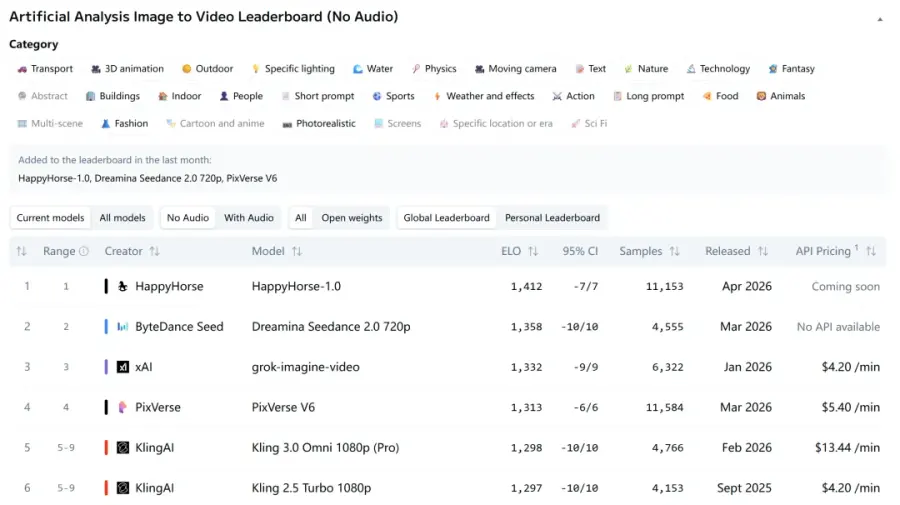
In that honest competition, Happy Horse-1.0 scored an ELO rating of 1,386 in text-to-video and 1,412 in image-to-video — numbers that put it clearly ahead of Seedance 2.0, which had only topped the charts days before.
How Happy Horse AI Performed Against the Competition
To understand just how striking this result was, consider the scoring gap. In most AI leaderboards, a difference of even 10 to 15 points between consecutive ranked models is significant. Happy Horse didn't just edge ahead — it led by roughly 74 points in the text-to-video category. The gap between the second-place model and the nineteenth-place model on that same leaderboard was barely enough to match Happy Horse's lead over Seedance 2.0. In leaderboard terms, that's an enormous margin.
Here's a quick look at how the models compared:
CategoryHappy Horse-1.0 ELOSeedance 2.0 ELODifferenceText-to-Video (no audio)1,386~1,31274Image-to-Video (no audio)1,412~1,34072Video with AudioSecond placeFirst placeSeedance leads
The one area where Seedance 2.0 still held an edge was in the audio-included categories, where it remained just ahead. That said, Happy Horse's sample count — around 3,500 votes — was still building toward Seedance's 7,500 when the rankings were captured, meaning the lead could grow further as more data comes in.
Who Built Happy Horse AI? The Identity Question
From the moment Happy Horse landed on the leaderboard, speculation ran wild. The name itself felt deliberate — 2025 is the Year of the Horse on the Chinese lunar calendar, and "Happy Horse" carries an almost playful energy. Within hours, AI communities on X (formerly Twitter) and Reddit were debating origins.
The Alibaba Theory Behind Happy Horse
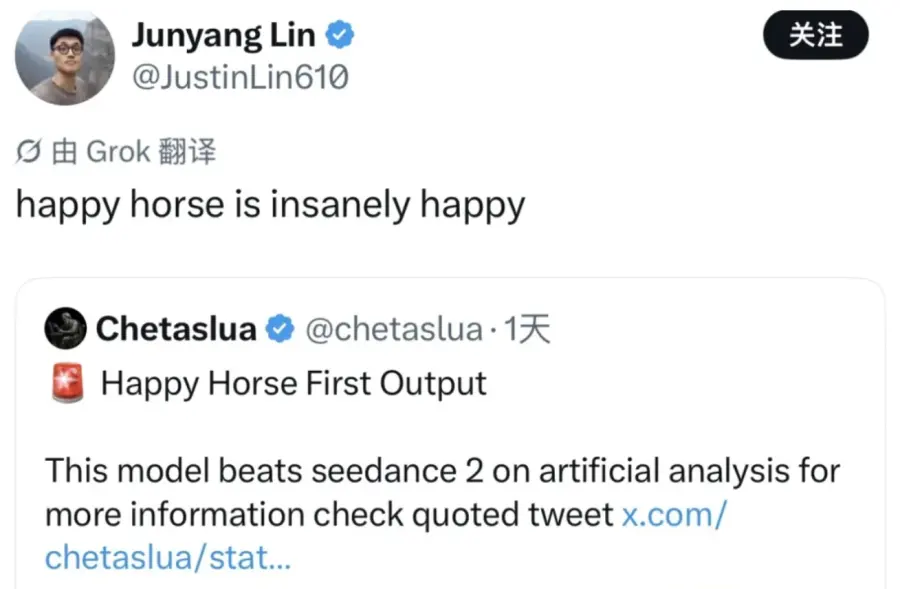
Two well-placed sources told The Information that Happy Horse was developed by Alibaba Group, and that Alibaba's cloud division was preparing to make the model available to enterprise clients. Adding weight to this theory, Lin Junyang, the former head of Alibaba's Qwen team, publicly shared Happy Horse-generated video samples on X and praised the results — a move that many interpreted as a knowing wink.
A separate but related rumor pointed to a team within Alibaba's Taobao-Tmall Group, led by Zhang Di, a senior executive with a long history in AI and video generation. Zhang Di was previously involved with Kling AI at Kuaishou, which built its own strong video model, before returning to Alibaba in late 2025. Whether he led this particular project or not, his presence at Alibaba aligns with the kind of talent that could produce a model at this level.
Why Chinese AI Companies Are Going Anonymous First
This isn't the first time a major Chinese AI team has chosen stealth over splash. The Information noted several recent examples of the same approach:
-
Xiaomi launched its MiMo-V2-Pro language model under the codename "Hunter Alpha" on OpenRouter
-
Zhipu AI's new GLM-5 model debuted as "Pony Alpha" before the company formally claimed it
-
Now Happy Horse follows the same pattern, generating massive attention before any official announcement
The logic is straightforward: anonymous models compete on merit alone. Leaderboard rankings are based on real-world performance, not brand recognition or marketing spend. The mystery also creates organic buzz that no press release can replicate.
What This Means for Developers and Teams Using AI Video
For anyone building with AI video models, the Happy Horse story isn't just interesting news — it has real practical implications. The AI video space is moving faster than almost any other AI category right now. What was the best model last month may not be the best model today.
Developers and teams face a recurring challenge: which model should they build on, and how do they stay flexible as the landscape shifts?
The risks of committing to a single provider are real. Pricing can change. API access can tighten. A model that sits at the top of rankings today can be displaced within weeks. When a team has baked one specific model deeply into their workflow, switching becomes expensive and time-consuming.
The smarter approach is to use a platform that gives you unified access to multiple models through a single integration. That way, when Happy Horse officially launches — or when the next surprise challenger appears — you can test and switch without rewriting your stack.
Access the Best Video AI Models Through GPT Proto
GPT Proto is built precisely for this situation. It's a unified AI API platform that connects developers and teams to the world's top AI models — text, image, and video — through a single API key and a single integration. You don't need to juggle multiple accounts or rewrite code every time a new model takes the lead.
For video specifically, GPT Proto already hosts a broad library of the leading models. You can explore all text-to-video models, image-to-video models, and video-to-video models in one place. As new breakout models like Happy Horse AI become available via API, platforms like GPT Proto are positioned to integrate them quickly so developers don't have to hunt down access on their own.
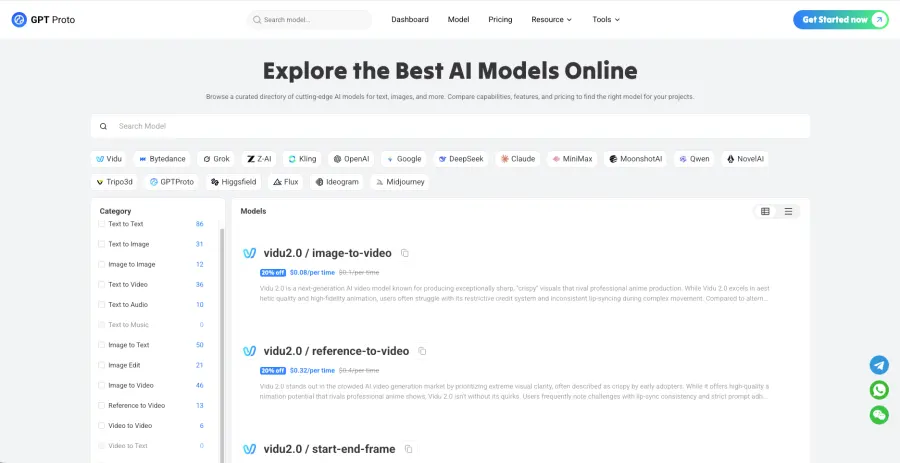
Here are some of the top video models currently available on GPT Proto:
-
Kling v3.0 Pro — strong multi-shot consistency and cinematic motion, starting at $0.27 per generation
-
Seedance 1.5 Pro — ByteDance's well-established model with high visual coherence
-
Wan 2.6 — Alibaba's existing video model, solid for dynamic content
-
Veo 3.1 Fast and Pro — Google's latest generation, excellent for speed and audio-visual sync
-
Hailuo 2.3 Pro and Hailuo-02-Pro — MiniMax's models with strong image-to-video capability
You can browse the full model library at GPT Proto and test any of them directly. Pricing is pay-as-you-go, with no monthly subscription required and rates that are consistently lower than going direct to providers.
The Bigger Picture — AI Video Competition Is Accelerating
The Happy Horse story arrives at a telling moment. OpenAI shut down Sora just weeks before, citing the cost of running a generative video service at scale alongside the pressure from a rapidly improving competitive field. Sora was the model that made the world take AI video seriously — but it couldn't maintain a lead once teams with deep video expertise started catching up.
What we're seeing now is a phase where Chinese AI teams, backed by the resources of companies like Alibaba, ByteDance, and Kuaishou, are producing models that match or exceed anything released by US labs in the video category. Seedance 2.0 dominated for about five days before Happy Horse appeared. That cycle is only going to speed up.
For developers, the takeaway is simple: the best video AI tool available today is probably not the best one that will be available in three months. Building on a flexible infrastructure that lets you swap models without friction isn't just convenient — it's becoming a competitive necessity.
FAQs About Happy Horse AI
What exactly is Happy Horse AI?
Happy Horse AI, also written as HappyHorse-1.0, is an anonymous AI video generation model that appeared on the Artificial Analysis leaderboard in April 2025. It topped the rankings in both text-to-video and image-to-video categories, surpassing Seedance 2.0 from ByteDance. As of this writing, the model has not been officially claimed by any company, though multiple sources point to Alibaba as the developer.
Who made Happy Horse?
According to reporting by The Information, two insiders identified Alibaba Group as the developer of Happy Horse. Alibaba's cloud division was reportedly preparing to open access to enterprise clients. Several pieces of circumstantial evidence — including a public post by a former Alibaba AI team leader — point in the same direction, though Alibaba had not made an official announcement at the time of this article.
Can I use Happy Horse AI right now?
Happy Horse AI does not currently have a publicly available API. It appeared on Artificial Analysis as an anonymous model, meaning it was accessible only through the leaderboard's evaluation process. As the model moves toward an official launch, API access is expected to follow. To stay ahead of these releases, platforms like GPT Proto AI API are worth monitoring — they typically integrate new top-performing models as API access becomes available.
What is the best AI video model I can use today?
That depends on your specific use case, but several strong options are available right now. For text-to-video, Kling v3.0 Pro and Wan 2.6 are consistently high performers. For image-to-video, Hailuo-02-Pro and Seedance 1.5 Pro are solid choices. For combined video and audio generation, Veo 3.1 Pro from Google offers excellent native audio sync. You can compare all of these and more on GPT Proto's model page, where you can test models directly and switch between them without changing your integration code.
Conclusion — Stay Ready for What's Next in AI Video
Happy Horse AI is a reminder that in this space, the landscape can shift in a week. A model nobody had heard of appeared, outperformed the current leader in blind testing, and set off weeks of industry speculation before even having a name attached to it. That's the pace of AI video development right now.
If you're building anything that relies on video generation, the practical lesson is to stay flexible. Use infrastructure that connects you to multiple models, gives you transparent pricing, and lets you adapt without rebuilding from scratch. GPT Proto AI API Platform is designed exactly for that — a single API that covers the full range of leading video, image, and language models, with pay-as-you-go pricing and no lock-in.
The next Happy Horse is already in development somewhere. When it drops, you'll want to be ready to test it immediately.