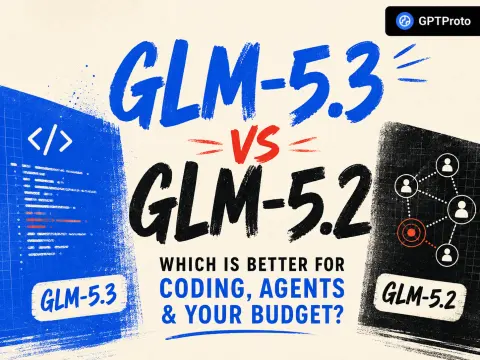
GLM-5.3 is the better model for difficult coding, terminal work, and long-running agents. GLM-5.2 remains the more flexible choice when you need downloadable weights, an established self-hosting setup, or requests with reasoning disabled.
This is not a traditional “new architecture versus old architecture” comparison. Z.ai says GLM-5.3 uses the same base model as GLM-5.2 and gets its improvements from additional post-training. The result is a model that performs better on long-horizon engineering tasks without charging a higher official per-token rate. The cost is less control over reasoning: GLM-5.3 always thinks, even on simple requests.
Both models are available through GPTProto at 10% below Z.ai’s list prices. You can compare the GLM-5.3 API with the GLM-5.2 API using one account, one balance, and the same OpenAI-compatible endpoint.
GLM-5.3 vs GLM-5.2: The 60-Second Answer
| Category |
GLM-5.2 |
GLM-5.3 |
Winner |
| Base model |
GLM-5.2 base |
Same base model |
Tie |
| Main upgrade |
Long-context coding and agents |
Expanded post-training for harder, longer tasks |
GLM-5.3 |
| Context window |
Up to 1M tokens |
Up to 1M tokens |
Tie |
| Maximum output |
Up to 128K tokens |
Up to 128K tokens |
Tie |
| Input modality |
Text only |
Text only |
Tie |
| Reasoning |
Can be disabled |
Always enabled |
Depends on workload |
| Reasoning effort |
More granular options |
low, high, max |
Depends on workload |
| Standard Z.ai API price |
$1.40 input / $4.40 output per 1M |
$1.40 input / $4.40 output per 1M |
Tie |
| GPT Proto API price |
$1.26 input / $3.96 output per 1M |
$1.26 input / $3.96 output per 1M |
Tie |
| Long-horizon coding |
Strong |
Substantially stronger in Z.ai’s tests |
GLM-5.3 |
| Self-hosting |
Weights available |
Weights were not yet public at this update |
GLM-5.2 |
| GPT Proto access |
Available |
Available |
Tie |
For a new coding-agent project, start with GLM-5.3. For a mature deployment that depends on thinking-off requests or local weights, keep GLM-5.2 until you have measured the migration on your own workload.
What Actually Changed?
Z.ai’s GLM-5.3 documentation says every improvement comes from post-training on the GLM-5.2 base. The company expanded training environments to resemble real professional work rather than short coding exercises. A task may require the model to inspect a repository, use tools, diagnose a problem, run experiments, and deliver a result that can be verified.
That training target explains the benchmark pattern. The largest gains appear in multi-step terminal, coding-agent, and cybersecurity tasks. The context window and input modality do not change.
The most important operational difference is reasoning control. GLM-5.2 can handle requests with thinking disabled. GLM-5.3 cannot. It supports only low, high, and max reasoning effort, with max as the default.
If an existing GLM-5.2 integration sends thinking.type: "disabled", changing only the model ID can cause the GLM-5.3 request to fail. Z.ai recommends enabling thinking and selecting reasoning_effort: "low" for the lightest GLM-5.3 mode.
Benchmark Breakdown: GLM-5.3 vs GLM-5.2
Z.ai reports consistent GLM-5.3 gains across coding, agents, and security. The size of the gain varies sharply by task.
| Benchmark |
GLM-5.2 |
GLM-5.3 |
Difference |
| Terminal-Bench 3.0 |
4.6 |
28.3 |
+23.7 |
| DeepSWE v1.1 |
46.2 |
66.9 |
+20.7 |
| Agents’ Last Exam |
23.8 |
28.5 |
+4.7 |
| AutomationBench |
26.2 |
48.2 |
+22.0 |
| HLE with tools |
54.7 |
62.5 |
+7.8 |
| CyberGym |
77.2% |
84.5% |
+7.3 points |
| ExploitBench |
24.4% |
54.4% |
+30.0 points |
These head-to-head results are vendor-reported. They are useful for identifying where Z.ai aimed the post-training, but they do not replace an evaluation on your repository and agent setup.
Independent testing is now available, so the model is no longer supported only by launch claims. Artificial Analysis records an Intelligence Index score of 60 for GLM-5.3 at max effort, a 1.92-second time to first token on Z.ai’s API, and unusually high output volume across its evaluation. That last point matters for budgeting: GLM-5.3 can be inexpensive per token and still consume many tokens.
Z.ai’s private Code Bench also gives a more direct efficiency comparison. At max effort, GLM-5.3 reached 34.5% at roughly 75,000 output tokens per task, while GLM-5.2 reached 23.4% at approximately 96,000. Because this is a private vendor benchmark, treat the figures as evidence to test—not a production guarantee.
GLM-5.3 vs GLM-5.2 for Coding
GLM-5.3 is the better choice for repository-scale engineering. Its largest published gains are on tasks that require more than generating a function: exploring a codebase, operating a terminal, repairing several files, running tests, and continuing until the result can be checked.
GLM-5.2 is still capable, and its maturity can matter more than the top benchmark score. If your current prompts, tool definitions, and retry logic are already tuned for GLM-5.2, an immediate switch creates a new validation job. Stability is a feature when production behavior has already been measured.
My coding verdict is simple: use GLM-5.3 for new difficult coding evaluations. Keep GLM-5.2 as a fallback until GLM-5.3 passes your regression set.
GLM-5.3 vs GLM-5.2 for Frontend Coding
Both models accept text, not images. Neither direct model route can inspect a screenshot, read a Figma frame, or compare a generated page with a visual reference. A separate vision model or service is required for screenshot-to-code and visual QA.
Given a detailed text specification, GLM-5.3 should be the first model to test for React, Vue, CSS, accessibility, state logic, and multi-file frontend refactors. The advantage comes from stronger coding and agent performance, not from a new visual capability.
The trade-off is prompt discipline. A 1M-token context does not compensate for an unclear design brief. Include component contracts, design tokens, breakpoints, browser targets, acceptance criteria, and the exact commands the agent should run.
GLM-5.3 vs GLM-5.2 for Agent Workflows
This is the clearest win for GLM-5.3. Z.ai expanded post-training around long-horizon, tool-using environments, and the largest benchmark gains appear on terminal and automation tasks.
GLM-5.3 is the better candidate for agents that inspect large repositories, call tools, run commands, or work across several stages without human supervision. GLM-5.2 remains useful for shorter workflows and mature production systems where its behavior is already known.
Mandatory reasoning changes the cost and latency profile. For routine agent steps—classifying an issue, selecting a file, or summarizing a tool result—GLM-5.3 at max effort may be unnecessary. Use low where the API route supports it, and reserve max for the steps that actually require deeper reasoning.
GLM-5.3 vs GLM-5.2 Pricing
Z.ai lists the same standard prices for both models. GPT Proto applies a 10% discount to the two routes:
| Charge type |
Z.ai list price per model |
GPT Proto price per model |
Saving |
| Input |
$1.40 |
$1.26 |
10% |
| Cached input |
$0.26 |
$0.234 |
10% |
| Output |
$4.40 |
$3.96 |
10% |
The list-price comparison ends in a tie. The task-cost comparison does not.
GLM-5.3 may solve a difficult job in fewer attempts, reducing the tokens spent on corrections. But it always reasons, and independent testing shows that it can be verbose. GLM-5.2 lets an application disable thinking for simpler requests, which can make it cheaper for high-volume workloads that do not benefit from a reasoning trace.
For a fair cost test, log:
Input, cached-input, and output tokens
Reasoning effort
Number of attempts
Total latency
Test or reviewer acceptance
Total cost for the accepted result
At GPT Proto’s discounted rate, every million input tokens saves $0.14 and every million output tokens saves $0.44 compared with Z.ai’s list price. Use the live GLM-5.3 model page and GLM-5.2 model page to confirm route status before estimating your production bill.
How to Compare GLM-5.3 and GLM-5.2 on GPT Proto
Use the same prompt, tools, time limit, and acceptance test. Change only the model ID. This cURL request tests GLM-5.3 through GPT Proto’s OpenAI-compatible endpoint:
curl "https://gptproto.com/v1/chat/completions" \
  --header "Authorization: Bearer $GPTPROTO_API_KEY" \
  --header "Content-Type: application/json" \
  --data '{
    "model": "glm-5.3",
    "messages": [
      {
        "role": "system",
        "content": "You are a senior software engineer. Follow the acceptance criteria and report the checks you performed."
      },
      {
        "role": "user",
        "content": "Review this migration plan, identify the three highest-risk dependencies, and propose a verification step for each."
      }
    ]
  }'
Run the same request again with "model": "glm-5.2". Do not compare one answer by tone alone. Score whether each risk is real, whether the verification steps are executable, how many corrections were needed, and how many tokens the accepted answer consumed.
Which Model Should You Choose?
Choose GLM-5.3 if you:
Are starting a new coding-agent evaluation
Need stronger long-horizon coding or terminal performance
Run agents that use tools across several stages
Want to test defensive vulnerability discovery or code review
Can keep reasoning enabled and tune its effort level
Choose GLM-5.2 if you:
Need downloadable weights or an established self-hosting workflow
Depend on requests with thinking disabled
Already have a production regression set tuned for GLM-5.2
Run simple, high-volume jobs where mandatory reasoning adds cost
Prefer to migrate only after GLM-5.3 passes your own acceptance tests
For most teams, the practical setup is not a permanent one-model decision. Use GLM-5.3 for the difficult steps, retain GLM-5.2 as a tested fallback, and route by task complexity.
The Bottom Line
GLM-5.3 wins the capability comparison. It is the stronger model for coding, agents, terminal work, and defensive security evaluation, and Z.ai charges the same official per-token rates as GLM-5.2. GPT Proto reduces those list rates by 10% for both routes.
GLM-5.2 wins on operational flexibility. It offers downloadable weights, an older deployment track record, and the option to skip reasoning on simple work.
If you are choosing a model for a new coding-agent project, start with the GLM-5.3 API on GPT Proto. If you already rely on GLM-5.2 in production, keep it as a fallback until the new route proves better on accepted-task cost, not just benchmark scores.